

1. The True Cost of Legacy Manual Tape Edging
Operational BottleneckRelying on outdated semi-manual workstations creates severe production ceilings and exposes factories to inconsistent stitch quality. Operators struggle with physical fatigue when flipping heavy mattresses, leading to uneven corner tension and high scrap rates.
Operational Impact Analysis
- Labor Dependency: Heavy reliance on veteran sewing technicians creates vulnerability and drives up overhead in competitive labor markets.
- Technical Solution: Modern Automatic Mattress Tape Edge Machines remove manual handling entirely, standardizing stitch alignment and reducing skill barriers.
2. Output Benchmarks: Semi-Automatic vs. Fully Automated Systems
Throughput EvaluationEvaluating production line capacity requires looking closely at beds per shift metrics. Semi-automatic units typically peak at 10-15 pieces per hour, whereas fully robotic systems scale output significantly higher.
Performance Parameter
- Cycle Time Variance: Manual corner turning introduces idle seconds that accumulate into lost hours over multi-shift operations.
- Technical Solution: Implementing automated conveyor feeding and pneumatic turning arms stabilizes output to 18-25 beds per hour per machine station.
3. Line Synchronization and Upstream-Downstream Bottlenecks
Plant IntegrationTape edging is the final sewing gateway before packing, making synchronization with upstream quilting and panel cutting vital. Unsynchronized stations cause mattress pile-ups and idle downstream packaging lines.
Engineering Parameter
- Flow Continuity: Mismatched cycle speeds between quilting buffers and taping stations disrupt total factory flow.
- Technical Solution: Integrating advanced machinery into a cohesive Infinity Mattress Machinery Official Website plant layout ensures balanced throughput across every production stage.
4. Servo-Driven Precision and Corner Deceleration Mechanics
Mechanical CalibrationHigh sewing speeds demand exact deceleration control when approaching mattress corners to prevent thread breakage and puckered seams. Mechanical clutch systems lack the micro-adjustments needed for high-speed consistency.
Dynamic Control
- Corner Distortion: Abrupt changes in direction cause thread snapping and loose stitches without real-time speed modulation.
- Technical Solution: Programmable servo motors automatically slow sewing speeds at corner approach points while maintaining uniform tension and stitch length.
5. Labor Optimization and Operator Fatigue Mitigation
Ergonomics & WorkforceManual mattress rotation during taping is one of the most physically demanding jobs on the factory floor, resulting in high turnover and repetitive strain injuries. Automated flipping mechanisms protect workers while sustaining peak speeds.
Ergonomic Factor
- Operator Strain: Continuous lifting of 30-50kg mattresses drains workforce energy and drops output during the second half of shifts.
- Technical Solution: Pneumatic lifting tables and robotic arms shoulder the physical burden, allowing a single operator to oversee multiple high-speed lines safely.
Essential Machinery for Scaling Production
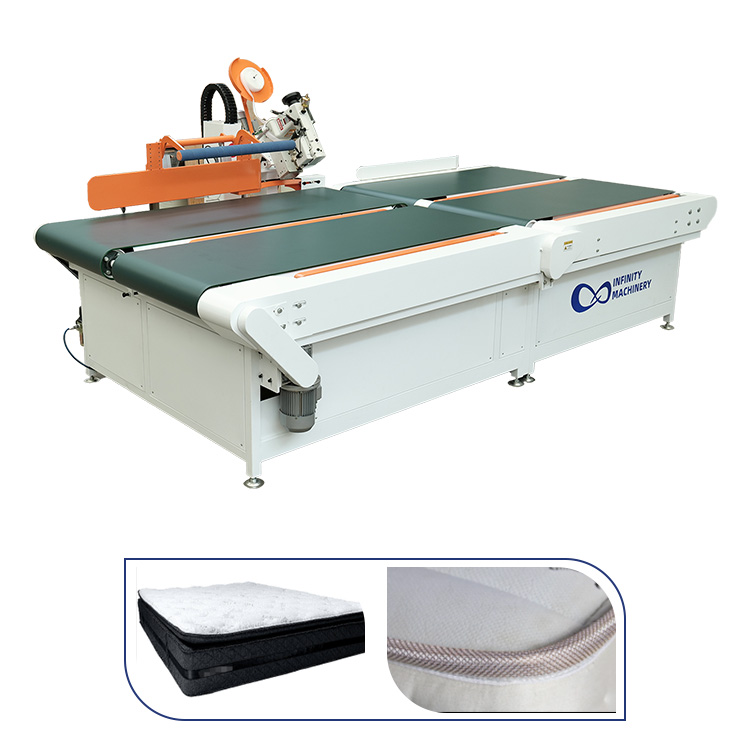
Features automatic rotation, flipping, and PLC program control with robotic arms to eliminate manual turning and maximize hourly bed output.

Equipped with advanced servo systems, automatic flipping, and precise positioning to deliver flawless edge finishes at high production speeds.
6. Maintenance Realities, Spare Parts Access, and Uptime Reliability
Equipment LongevityFactory profitability depends on machine uptime. Complex proprietary machinery with hard-to-source components can lead to catastrophic downtime when mechanical wear occurs.
Maintenance Metric
- Component Wear: High-friction sewing heads and guide rails require durable materials and accessible lubrication points to prevent seizing.
- Technical Solution: Industrial designs featuring standardized modular components and automatic oil supply systems ensure minimal maintenance overhead and continuous plant operation.
7. Calculating Total Cost of Ownership (TCO) and ROI Payback Periods
Financial EvaluationInvesting in capital equipment requires looking past initial purchase price to evaluate labor savings, reduced fabric scrap, and increased daily bed output. Automated machinery consistently demonstrates rapid capital recovery.
Investment Return
- Cost Per Bed: Reducing labor headcounts and eliminating rework directly slashes manufacturing overhead per mattress.
- Technical Solution: High-throughput automated tape edge systems typically achieve full ROI within 12 to 18 months through labor reduction and output scaling.
Strategic Plant Investment Summary
Replacing slow, labor-heavy legacy taping stations with automated, reliable equipment like Infinity Mattress Machinery solutions is the definitive strategy for reducing cost-per-bed, maximizing output per shift, and securing long-term factory profitability.
Ready to Optimize Your Factory Line?
Contact our engineering team today for custom plant layouts, production benchmarking, and competitive machinery quotes.


