

1. The Hidden Bottleneck of Manual Corner Seaming
Operational BottleneckManual tape edging exposes production lines to severe operator fatigue, inconsistent stitch spacing, and bunched corners on thick pillow-top builds. When workers manually push heavy mattresses through legacy tables, physical strain leads to jagged corners and rejected units that directly inflate your factory scrap rate.
Operational Parameter: Labor Fatigue vs. Output Stability
- Legacy Limitation: Manual manipulation relies entirely on operator dexterity, leading to production slowdowns during shifts and high vulnerability to repetitive strain injuries.
- Technical Solution: Deploying an automated tape edge system standardizes the handling cycle, completely removing manual lifting friction from the finishing stage.
2. Precision Servo Control and Automatic Corner Deceleration
Mechanical CalibrationMaintaining a flat, crisp edge around a 90-degree corner requires instantaneous speed reduction without needle deflection or thread snapping. Modern engineering utilizes multi-axis servo drives that calculate mattress positioning in real time to slow down exactly at transition points.
Engineering Analysis: Dynamic Deceleration Curves
- Core Principle: Fixed-speed legacy motors cause needle strain and fabric distortion when executing tight 90-degree turns on multi-layered quilted panels.
- Technical Solution: Servo-driven sewing heads automatically decelerate upon approaching corners, ensuring uniform stitch density and flat, professional edge profiles.
3. Robotic Flipping and Eliminating Operator Dependency
Automation & WorkflowRelying on veteran operators to manually flip 50-kilogram mattress panels creates a critical labor bottleneck that restricts daily plant output. Integrating automated conveyor routing and robotic positioning arms allows plants to maintain high-speed throughput across multi-shift operations.
Material Property: Handling Heavy-Duty Assemblies
- Diagnostic Factor: Heavy high-profile mattresses resist smooth manual rotation, causing tape slippage and crooked side panels.
- Technical Solution: Utilizing a high-speed automatic tape edge machine equipped with pneumatic corner turners guarantees exact alignment without manual intervention.
4. Maintaining Consistent Fabric Tension Across High-Profile Builds
Tension ControlThick luxury mattresses containing multiple foam layers and quilted panels are highly susceptible to puckering if binder tension fluctuates during sewing. Precise mechanical synchronization between the feeding belt and the sewing head is mandatory to eliminate wrinkles.
Technical Parameter: Edge Puckering Prevention
- Material Insight: Uncontrolled fabric stretch on high-profile borders results in loose upper tapes and uneven flange gathering.
- Technical Solution: Adjustable presser feet and synchronized feeding mechanisms maintain constant downward pressure, locking all material layers together uniformly.
5. Minimizing Scrap and Thread Breakage Downtime
Quality AssuranceFrequent thread breaks and fabric jams waste expensive binding tape and consume valuable technician hours clearing jams. Advanced machinery incorporates intelligent sensor arrays that detect thread anomalies instantly before defects propagate down the panel.
Diagnostic Step: Automated Error Detection
- Core Principle: Undetected lower thread exhaustion creates unstitched gaps, forcing costly manual rework or total panel scrap.
- Technical Solution: Infrared thread break sensors instantly halt operations upon failure, preserving stitch continuity and preventing material damage.
Essential Machinery for Scaling Production
High-Efficiency Tape Edge Solutions
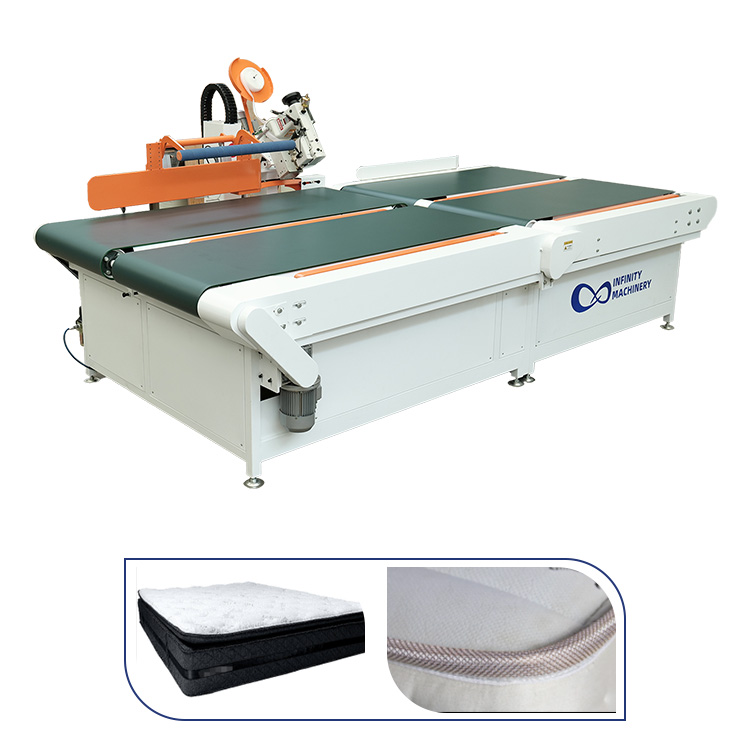
Features a robotic arm, automatic 90-degree turning, and PLC control to eliminate manual handling and deliver flawless corner seams.

Equipped with advanced servo systems, automatic flipping, and precise head positioning designed for high-volume mattress manufacturing lines.
6. Integrating Tape Edge Systems into Scalable Plant Layouts
Plant EngineeringUpgrading individual workstations is only effective when synchronized with upstream panel preparation and downstream packaging flows. Designing a cohesive smart mattress tape edge production line prevents work-in-progress pileups and balances hourly factory throughput.
Operational Parameter: Workflow Synchronization
- Core Principle: Isolated high-speed machines create bottlenecks if upstream quilting and panel cutting rates do not match finishing speeds.
- Technical Solution: Modular conveyor integration links tape-edge units directly with inspection and packing stations to maintain a continuous, uninterrupted manufacturing rhythm.
7. Long-Term Durability and Routine Maintenance Protocols
Maintenance & DurabilityHeavy industrial sewing environments demand robust mechanical construction to withstand continuous high-speed friction and multi-shift operation. Selecting machines built with hardened steel guide rails and automatic lubrication systems minimizes unexpected maintenance downtime.
Engineering Analysis: Lifecycle Cost Optimization
- Core Principle: Sub-standard components wear out quickly under high tension, leading to costly service calls and erratic stitching quality.
- Technical Solution: Premium cast-iron frames, sealed bearings, and automated oil delivery protect internal mechanisms, ensuring long-term operational stability.
Strategic Plant Investment Takeaway
Transitioning from legacy manual workstations to advanced automated tape edge machinery is the definitive strategy for reducing cost-per-bed, eliminating operator dependency, and securing long-term factory profitability. By investing in precision servo-driven equipment like those from Infinity Mattress Machinery, plant owners achieve zero-defect corner consistency, maximize shift output, and future-proof their manufacturing operations.
Ready to Upgrade Your Mattress Production Line?
Contact our engineering specialists today for customized plant layouts, technical specifications, and direct factory pricing.

