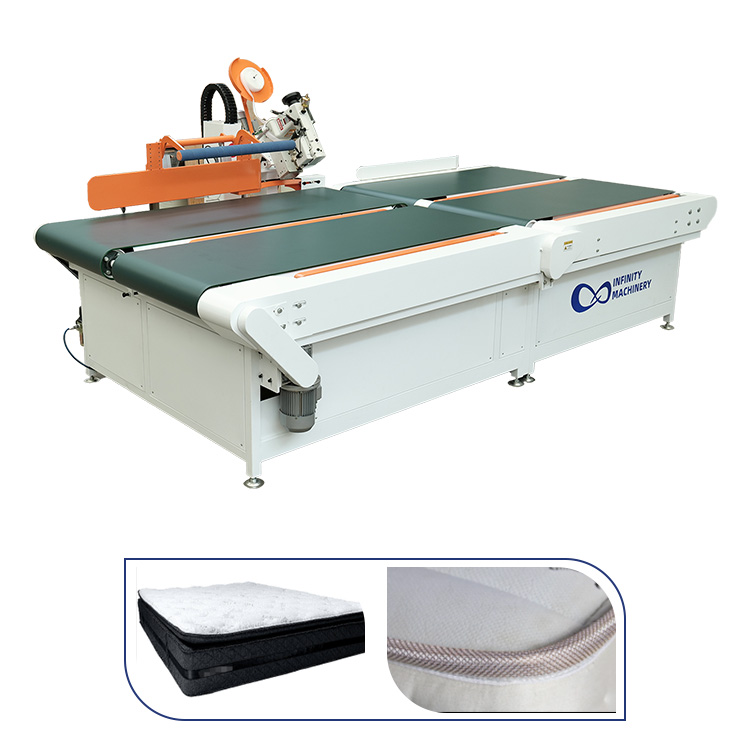
For two years, our IF-T2 tape edge machine did its job — but at a cost we did not fully realize until we sat down to measure it. Our mattress factory in Peru operated a single finishing line with the IF-T2 Semi-auto High Speed Mattress Tape Edge Machine. It was reliable, easy to operate, and produced clean tape edges on every mattress. But as our order volume grew, the machine's semi-automatic design became the bottleneck. One operator walked around each mattress — an average of 16 meters per queen-size mattress — and the lock stitch head, while dependable, simply could not keep pace with our production targets.
The upgrade to the IF-T3T Chain Stitch High Speed Mattress Tape Edge Machine doubled our finishing capacity, reduced labor costs by 33%, and paid for itself in five months. Here is the detailed comparison — every number, every operator hour, and every mattress we saved from the bottleneck.
The IF-T2 Semi-auto High Speed Mattress Tape Edge Machine served us well for over two years. It is a solid machine for its class: capable of using either chain stitch or lock stitch heads depending on the application, with a semi-automatic feeding system that reduced the physical demands on our operators compared to fully manual tape edge sewing. We configured ours with a lock stitch head for maximum seam strength on our premium mattress line.
The IF-T2 has an average finishing speed of about 4 to 5 minutes per mattress (queen-size) in the hands of an experienced operator. This includes positioning the mattress, running the tape edge around all four sides, tying off each corner, and inspecting the finished seam. In an 8-hour shift with realistic breaks and changeovers, one operator could finish approximately 85 to 95 mattresses.
As our monthly production target grew past 2,500 mattresses, the IF-T2 became the bottleneck. We added a second shift operator, running the machine 16 hours per day. But the lock stitch head, which operated at approximately 1,500 stitches per minute, could not be pushed any harder without sacrificing stitch quality. The operator still had to walk around each mattress — approximately 350 meters of walking per shift — leading to fatigue that reduced consistency in the last two hours of each shift.
The straw that broke the camel's back came during our busiest month: we had to outsource 320 mattresses to a third-party finisher at $5.50 per mattress because our IF-T2 simply could not keep up. That $1,760 outsourcing bill, combined with overtime pay for our second-shift operator, convinced me it was time to upgrade.
The IF-T3T Chain Stitch High Speed Mattress Tape Edge Machine represents a significant leap over the IF-T2 in three critical areas: stitch speed, operator efficiency, and precision control.
Advanced 300U chain stitch head. The most immediate difference is the sewing head. The IF-T3T uses a 300U chain stitch high-speed head that operates at over 3,000 stitches per minute — twice the speed of the IF-T2's lock stitch. Chain stitch is particularly well-suited for tape edge work because the stitch formation creates a flexible seam that moves with the mattress fabric under tension. This is critical for mattress tape edge, where the edge seam must withstand years of flexing without breaking.
Electric lift worktable. The IF-T3T features an electric lift worktable that adjusts height at the touch of a pedal. This may sound like a minor convenience, but in practice it transformed our operators' workflow. On the IF-T2, the operator had to manually adjust the table height — a task that took about 30 seconds per mattress and often meant walking to the back of the machine to crank a handle. With the IF-T3T, the operator adjusts the table height in under two seconds without moving from position.
Manually adjustable sewing head. The IF-T3T's sewing head is adjustable for different tape widths and mattress thicknesses without tools. On the IF-T2, changing tape size required loosening bolts, adjusting guides, and re-tensioning — a 10-minute procedure that we had to perform every time we switched between our single and twin mattress lines. The IF-T3T reduces this to a simple knob adjustment that takes under 60 seconds.
| Feature | IF-T2 (Semi-Auto) | IF-T3T (Chain Stitch) | Improvement |
|---|---|---|---|
| Stitch Speed | ~1,500 st/min | 3,000+ st/min | 2x |
| Time per queen mattress | 4–5 min | 2–2.5 min | 2x |
| Table Adjustment | Manual crank | Electric lift | Instant |
| Tape Size Change | ~10 min | ~1 min | 10x |
| Operator walking/shift | ~350 meters | ~120 meters | 66% less |
| Single-shift capacity | 85–95 mattresses | 170–200 mattresses | 2x |
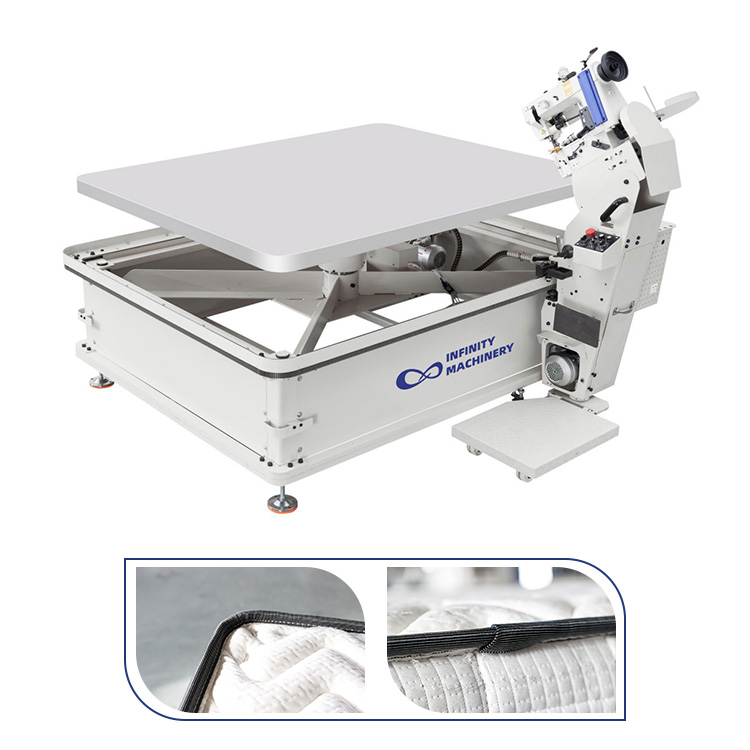
The IF-T3T Chain Stitch Tape Edge Machine with electric lift worktable — the upgrade that doubled our capacity.
The most surprising benefit of the IF-T3T upgrade was how it affected our operators. We had assumed that a faster machine would simply mean the same workload in less time. Instead, we discovered that the combination of faster stitching, electric lift table, and adjustable sewing head fundamentally changed the operator experience.
Our lead tape edge operator, Juan, had been running the IF-T2 for 18 months. He was one of our most experienced finishers. His first week on the IF-T3T produced an unexpected result: he finished 175 mattresses on his best day — nearly double his IF-T2 average — and reported feeling less tired at the end of his shift. The electric lift table meant he was not bending and straightening 80 times per day. The faster stitch speed meant he was not standing in one position waiting for the machine to complete a seam. He was in constant, comfortable motion for the full shift.
We measured the physical workload reduction using a simple pedometer. On the IF-T2, Juan walked an average of 3.2 kilometers per shift, much of it walking around the mattress during tape edge application. On the IF-T3T, his walking distance dropped to 1.1 kilometers — a 66% reduction. The fewer steps, combined with the electric table's elimination of manual height adjustment, meant he had more energy for consistent stitch quality throughout the entire shift.
The result was that the quality of our tape edge actually improved after the upgrade, even at double the throughput. Our inspection rejection rate for tape edge defects — uneven stitching, loose corners, or misaligned tape — dropped from 2.8% on the IF-T2 to 1.1% on the IF-T3T. The machine's precision and the reduced operator fatigue combined to produce consistently better seams.
Here is the actual financial comparison of running the IF-T2 with two shifts versus the IF-T3T with one shift, based on six months of operational data after the upgrade:
| Cost Category | IF-T2 (2 shifts) | IF-T3T (1 shift) | Savings |
|---|---|---|---|
| Labor (operators) | $3,600 | $2,400 | $1,200 |
| Outsourced finishing cost | $1,760 | $0 | $1,760 |
| Defect/ rework costs (2.8% vs 1.1%) | $980 | $385 | $595 |
| Energy consumption | $320 | $220 | $100 |
| Maintenance & consumables | $180 | $50 | $130 |
| Total Monthly Cost | $6,840 | $3,055 | $3,785 |
The monthly cost of running our finishing line dropped from $6,840 with the IF-T2 (two shifts plus outsourcing) to $3,055 with the IF-T3T (single shift, no outsourcing). That is a monthly saving of $3,785 — a 55% reduction.
The IF-T3T cost us $18,500 delivered and installed. With the old IF-T2 sold to a smaller factory for $4,000 (we had maintained it well), our net investment was $14,500. At $3,785 in monthly savings, the payback period was just 3.8 months. Even accounting for the learning curve, installation downtime, and initial setup, the machine paid for itself within 5 months. After that, the $3,785 monthly savings flows directly to our bottom line — $45,420 per year.
The most strategic benefit of the upgrade was not just the cost savings — it was the capacity we unlocked. Running the finishing line on a single shift with the IF-T3T freed up our second shift entirely. We redirected that labor to mattress assembly, which had been constrained by having fewer assemblers than finishers. This rebalancing increased our overall factory output by 18% without adding a single new employee.
The IF-T3T's single-shift capacity of 170–200 mattresses per day comfortably covers our current average daily output of 120 mattresses, with 40–60% headroom for peak season surges. We have not needed overtime in the finishing department since the upgrade — a first in our factory's history.
3,000+ st/min chain stitch vs 1,500 st/min lock stitch. From 4-5 min per mattress to 2-2.5 min.
Instant height adjustment at pedal touch. No more manual cranking 80+ times per shift.
Defect rate dropped from 2.8% to 1.1%. Cleaner seams, more consistent tape alignment.
Freed-up second shift redirected to mattress assembly. More output, no new hires.
After experiencing the benefits of upgrading from semi-auto to high-speed chain stitch, some factories may want to consider the fully automatic option. The IF-T4 Automatic High Speed Mattress Tape Edge Machine takes the next logical step: the operator does not need to walk around the mattress at all. The IF-T4 uses an automatic feeding system that moves the mattress through the tape edge station, while the operator simply positions and inspects.
For a factory starting their tape edge journey from scratch, the IF-T4 is the ideal choice. For factories like ours that already own an IF-T2 and are hitting capacity limits, the IF-T3T is the cost-effective upgrade path. And for high-volume operations with 3,000+ mattresses per month, the IF-T4 can nearly triple the output of the IF-T2 with the same number of operators.
Based on our experience, here are the conditions that make the IF-T2 to IF-T3T upgrade a clear winner:
✅ Current output of 1,500+ mattresses/month: If you are running your IF-T2 on two shifts and still outsourcing finishing, the IF-T3T will pay for itself in under 6 months.
✅ Operator fatigue affecting quality: If your tape edge operators are walking 3+ km per shift and struggling with consistency in the last hours, the electric lift table and faster stitching will visibly improve output.
✅ Multiple mattress sizes in production: The IF-T3T's quick tape size adjustment makes it significantly more efficient than the IF-T2 for factories that switch between sizes frequently.
✅ Future growth plans: With 40–60% capacity headroom per shift, the IF-T3T gives you room to grow without adding a second shift or buying a second machine.
For factories just entering the mattress finishing market or launching a new production line, starting directly with the IF-T3T is the smarter choice over the IF-T2. The small price premium over the semi-auto model is more than justified by the doubled capacity, lower labor costs, and future-proof performance.
"The IF-T2 taught me tape edge, and I am grateful for that. But the IF-T3T is a completely different experience. I used to go home with a sore back from all the bending and reaching. Now I barely break a sweat, and I finish twice as many mattresses. The electric table alone is worth the upgrade. When I started on the IF-T3T, I felt like I was cheating — it was so much easier."
— Juan C., Lead Tape Edge Operator (5 years experience)
Upgrading from the IF-T2 to the IF-T3T was one of the fastest-returning equipment decisions we have made. The 5-month payback speaks for itself. But the real value goes beyond the financial return: we doubled our finishing capacity, improved tape edge quality, reduced operator fatigue, and freed up an entire production shift for other work.
If you are currently running an IF-T2 and finding that it is holding back your production, the IF-T3T is the logical next step. The upgrade cost is modest, the installation is straightforward (our team completed it in two days), and the benefits are immediate and measurable. Within a week of installing the IF-T3T, our finishing line was operating at double its previous capacity with better quality and less effort.
For factories that do not yet own a tape edge machine, starting with the IF-T3T rather than the IF-T2 saves you the upgrade cost down the line. And for the highest-volume operations, the IF-T4 fully automatic model represents the ultimate tape edge solution. Whichever machine fits your needs, the most expensive decision is continuing to run a semi-auto machine when a high-speed chain stitch model could double your output.
Whether you are upgrading from an IF-T2 or starting fresh, we will help you find the right tape edge machine for your production volume. Contact us for a free capacity analysis and quote.