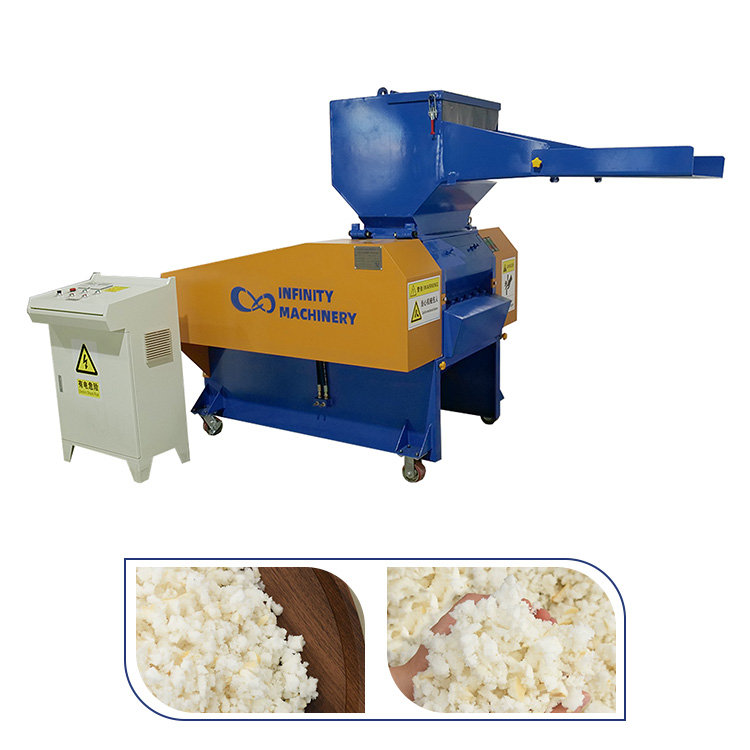
Every mattress factory generates foam waste — off-cuts, defective blocks, and production scraps. Instead of paying to dispose of this material, forward-thinking manufacturers are converting it into rebonded foam that sells for $800-1,200 per cubic meter. The IF-FZS Re-Bonding Foam Machine makes this transformation simple, fast, and profitable.
Most mattress factories treat foam scraps as garbage. They pay $50-150 per ton to haul waste foam to landfills. But this "waste" is actually virgin material in disguise. A typical factory producing 200 mattresses daily generates 300-500 kg of foam off-cuts per month. At landfill disposal rates of $100/ton, that is $30-50 per month just to throw away material that could be resold.
The real opportunity lies in rebonding technology. The IF-FZS Re-Bonding Foam Machine takes those same foam scraps, processes them through a controlled binding and compression cycle, and outputs solid rebonded foam blocks that meet industry quality standards. The blocks sell for $800-1,200 per cubic meter to furniture manufacturers, carpet underlay producers, and even other mattress factories.
Consider the numbers for a mid-sized operation. Your factory produces 200 mattresses daily using a mix of foam types. Each mattress uses approximately 8-12 kg of foam for the core and comfort layers. During cutting and assembly, you lose roughly 15-20% of that foam as off-cuts. That means 240-480 kg of foam waste per day, or 6,000-12,000 kg per month.
At current market prices, that wasted foam represents $4,800-9,600 in raw material value every month. Without a rebonding machine, this value goes straight to the landfill. With the IF-FZS, you capture 80-95% of that value as sellable rebonded foam blocks.
The math is stark: instead of paying $50-100/month to dispose of waste, you generate $6,000-12,000/month in revenue from that same material. That is a $6,000-12,000 monthly swing from cost center to profit center.
The IF-FZS operates through a four-stage process that transforms loose foam scraps into dense, uniform rebonded blocks. Understanding each stage helps you optimize the machine for your specific foam types and output requirements.
Foam scraps from cutting operations, defective blocks, and production waste are collected and sorted. The IF-FZS can process mixed foam types, making it versatile for various waste streams. There is no need to separate materials by density — the machine handles the blending automatically.
The foam pieces are fed into the crushing chamber where rotating blades break them down into uniform particles. This ensures consistent density in the final rebonded block. The particle size can be adjusted to match different end-use requirements.
A precise amount of binding agent is sprayed onto the foam particles. The IF-FZS uses an automated dosing system that ensures optimal adhesion without excess chemical usage. The binding agent is applied evenly throughout the particle mix, guaranteeing strong bonds in the finished block.
The treated foam particles are compressed in the molding chamber under high pressure. The machine maintains pressure during the curing process, typically 4-8 hours depending on block size and binding agent type. Once cured, the rebonded foam block is ejected — dense, uniform, and ready for sale or further processing.
The IF-FZS processes foam scraps continuously without stopping. Feed material in one end, get finished rebonded blocks out the other. No batch delays, no manual handling between stages.
Adjust output density from 60-120 kg/m³ to match customer specifications. Whether you are making mattress bases, carpet underlay, or furniture padding, the IF-FZS delivers consistent results every time.
The 15KW motor consumes minimal electricity. Binding agents cost approximately $0.15 per kg of processed foam. Total operating cost stays below $200/month for most factories, making the return on investment exceptionally fast.
Meet increasingly strict environmental regulations across global markets. The IF-FZS enables true zero-waste foam processing, positioning your factory as an environmentally responsible manufacturer.
A mattress factory in Southeast Asia producing 300 mattresses per day installed the IF-FZS to handle their foam waste stream. Before installation, they were paying approximately $150/month to dispose of 8 tons of foam scraps monthly. The foam went to landfills, contributing to environmental pollution and offering zero return.
After installing the IF-FZS, the same 8 tons of foam scraps now produce approximately 6.5 tons of rebonded foam blocks (accounting for binding agent weight and process losses). At a selling price of $900 per cubic meter and an average density of 80 kg/m³, each ton of rebonded foam is worth approximately $1,125.
The math: 6.5 tons × $1,125/ton = $7,312.50 per month in revenue from material that was previously being thrown away. After subtracting operating costs of $200/month for electricity and binding agents, the net monthly gain is $7,112.50.
The IF-FZS investment of approximately $28,000 pays for itself in under 4 months. After that, every month generates pure profit from what was previously a cost center. Over three years, this single machine generates over $250,000 in additional revenue.
Infinity Machinery offers two complementary machines for foam waste processing: the IF-FZS Re-Bonding Foam Machine and the IF-FFS3 Crushing Foam Machine. Understanding when to use each — or both together — maximizes your return on investment.
Many factories use both machines together: the IF-FFS3 pre-processes large foam scraps into uniform particles, which are then fed into the IF-FZS for rebonding. This combination maximizes throughput and ensures consistent output quality. The IF-FFS3 handles 200-500 kg per hour, feeding the IF-FZS's 300 kg batch capacity perfectly.
Setting up the IF-FZS in your factory requires careful planning to maximize efficiency. The machine needs approximately 15-20 square meters of floor space, including material staging areas and curing zones. Here is a recommended layout for a typical installation:
Zone 1 - Collection Area (3-5 sqm): Position near your foam cutting stations to minimize material handling. Use large bins or conveyors to transport scraps directly from cutting machines to the IF-FZS input hopper.
Zone 2 - Processing Area (8-10 sqm): The IF-FZS machine itself, with 1-meter clearance on all sides for maintenance access. Ensure adequate ventilation for the binding agent application process.
Zone 3 - Curing Area (4-6 sqm): Space for freshly pressed blocks to cure. Blocks typically need 4-8 hours to fully cure. Stack cured blocks on pallets for easy forklift access.
Power requirements include a dedicated 380V/50Hz three-phase circuit capable of handling the 15KW motor. Compressed air supply at 0.5-0.8 MPa is needed for the pneumatic systems. The machine should be positioned on a level concrete floor with proper drainage for any liquid waste from the binding process.
Training typically takes 2-3 days for basic operation, with an additional week for advanced tuning. Infinity Machinery provides comprehensive on-site training with every machine purchase.
The global rebonded foam market is growing at 6-8% annually, driven by increasing demand for cost-effective cushioning materials. Furniture manufacturers, mattress producers, carpet underlay companies, and automotive suppliers all purchase rebonded foam as a cost-effective alternative to virgin foam.
Furniture Industry: Sofa cushions, chair padding, and mattress foundations account for approximately 45% of rebonded foam demand. These applications value the consistent density and durability that rebonded foam provides at a fraction of virgin foam cost.
Carpet Underlay: The carpet underlay market consumes roughly 30% of all rebonded foam production. High-density rebonded foam (80-100 kg/m³) provides the resilience and durability needed for quality carpet installations.
Automotive Industry: Growing demand for sustainable materials in vehicle interiors is creating new opportunities for rebonded foam in seat cushions, headliners, and trim components.
This expanding market means consistent demand for your rebonded foam output. Factories with IF-FZS machines can sell their output directly to these industries, creating a reliable revenue stream from what was previously waste.
The IF-FZS is engineered for durability in continuous industrial environments. With proper maintenance, the machine delivers consistent performance for 15+ years. Here is the recommended maintenance schedule:
Daily Maintenance (10 minutes): Inspect the input hopper for blockages. Check binding agent levels in the reservoir. Wipe down the compression chamber seals. Verify that the pressure gauge reads within normal range.
Weekly Maintenance (30 minutes): Lubricate all moving parts according to the maintenance schedule. Inspect the crushing blades for wear and sharpen or replace as needed. Check hydraulic fluid levels and top off if necessary. Clean the binding agent spray nozzles to prevent clogging.
Monthly Maintenance (1-2 hours): Perform a comprehensive inspection of all mechanical and electrical components. Calibrate the pressure system. Check belt tension and alignment. Inspect the compression plate for wear. Test all safety interlocks and emergency stop functions.
Annual maintenance should include a complete system overhaul by a qualified technician. This typically takes 4-6 hours and costs approximately $500-800 depending on parts needed. Infinity Machinery stocks all replacement parts and can ship globally within 48 hours.
The machine's robust construction uses industrial-grade steel frames, hardened crushing blades, and high-quality hydraulic components. Most IF-FZS machines operate continuously for 8+ hours per day with minimal downtime, achieving 95%+ uptime rates.
Foam waste is a significant environmental concern. Traditional disposal methods send thousands of tons of non-biodegradable polyurethane foam to landfills each year. A single mattress factory generating 500 kg of foam waste daily contributes approximately 182 tons of material to landfills annually — material that will persist in the environment for hundreds of years.
The IF-FZS transforms this environmental liability into an economic asset. By converting waste foam into rebonded blocks, the machine eliminates 100% of foam waste disposal. There is no landfill contribution, no transportation emissions from waste hauling, and no groundwater contamination risk from degrading foam materials.
Beyond direct environmental benefits, rebonded foam production supports the circular economy. The finished blocks replace virgin foam in many applications, reducing the demand for petrochemical-based raw materials. Each ton of rebonded foam produced saves approximately 2.5 barrels of crude oil that would otherwise be used to manufacture virgin polyurethane foam.
Many countries are implementing stricter foam waste regulations. The European Union's Waste Framework Directive and similar legislation in Asia and the Americas are pushing manufacturers toward zero-waste operations. Factories with IF-FZS machines are already compliant with these emerging standards, while those without face increasing disposal costs and potential regulatory penalties.
The sustainability narrative also strengthens your brand positioning. Customers and business partners increasingly value environmentally responsible manufacturing practices. Having a documented zero-waste foam processing system demonstrates your commitment to sustainability and can be a powerful differentiator in competitive bids.
Use this framework to calculate your specific return on investment. The numbers below represent a typical mid-sized mattress factory, but you should substitute your own figures for an accurate assessment.
Step 1: Calculate your foam waste volume. Measure or estimate the total weight of foam scraps generated per month. Include off-cuts from cutting operations, defective blocks, production rejects, and any other foam material currently being disposed of. For a factory producing 200 mattresses daily, this typically ranges from 300-500 kg per month.
Step 2: Determine current disposal costs. Contact your waste management provider to get current disposal rates. These typically range from $50-150 per ton for foam waste, depending on your location and volume. Multiply your monthly waste volume by this rate to get your current monthly disposal cost.
Step 3: Estimate rebonded foam output. The IF-FZS processes foam at 80-95% efficiency, meaning you can expect to recover 80-95% of your input foam weight as finished rebonded blocks. For 400 kg of monthly waste, expect 320-380 kg of rebonded foam output.
Step 4: Calculate potential revenue. Rebonded foam sells for $800-1,200 per cubic meter depending on density and market conditions. At 80 kg/m³ density, 320 kg of rebonded foam equals 4 cubic meters, worth $3,200-4,800 at market prices.
Step 5: Subtract operating costs. Monthly operating costs for the IF-FZS include electricity ($45-60), binding agents ($50-80), and maintenance labor ($100-150). Total monthly operating cost: approximately $200.
Step 6: Calculate net benefit. Subtract operating costs from revenue, then add back the disposal costs you no longer pay. For our example: $4,000 revenue - $200 operating + $100 saved disposal = $3,900 net monthly benefit. At an IF-FZS investment of $28,000, payback period is approximately 7 months. However, many factories achieve faster payback through higher waste volumes or premium market pricing.
Operating the IF-FZS requires adherence to standard industrial safety practices. The machine includes multiple safety features designed to protect operators and ensure consistent production. Emergency stop buttons are positioned at both the input and output ends of the machine, allowing immediate shutdown from any position.
The compression chamber includes safety interlocks that prevent the machine from operating when the chamber doors are open. Hydraulic pressure relief valves protect against over-pressurization, and the binding agent system includes ventilation to prevent fume accumulation in the work area.
Operators should wear appropriate personal protective equipment including safety glasses, dust masks, and gloves when handling binding agents. The work area should have adequate ventilation, and a fire extinguisher should be positioned within easy reach. Infinity Machinery provides comprehensive safety documentation with every machine purchase.
The IF-FZS carries CE certification and meets all applicable safety standards for industrial foam processing equipment. Regular safety inspections and operator training ensure ongoing compliance with workplace safety regulations.
Beyond basic rebonded foam blocks, the IF-FZS opens doors to specialized product development that can command premium pricing. By adjusting density, block dimensions, and binding agent formulations, manufacturers can create tailored foam products for specific market segments.
High-Density Applications (100-120 kg/m³): Producing high-density rebonded foam enables entry into the carpet underlay market, where densities of 80-100 kg/m³ are standard. This market segment commands premium pricing and has consistent year-round demand from flooring installers and commercial building projects.
Custom Density Blending: By mixing different foam types and adjusting the binding agent ratio, the IF-FZS can produce custom-density blocks that meet specific customer requirements. This capability is particularly valuable for furniture manufacturers who need foam with specific firmness characteristics for different product lines.
Multi-Layer Products: Advanced users can create multi-density foam blocks by layering different rebonded densities within a single block. This technique produces gradient foam that provides varying support levels — soft on the surface, firmer in the core — without the cost of using virgin foam layers.
Specialty Markets: Rebonded foam is increasingly used in pet bedding, yoga mats, sports equipment padding, and acoustic insulation panels. Each of these markets has specific density and durability requirements that the IF-FZS can meet through process optimization.
The key to maximizing revenue from your IF-FZS investment is understanding your local market demand and tailoring your output specifications accordingly. Contact Infinity Machinery's technical team for guidance on optimizing your rebonded foam output for specific market segments.
Many factories start with a single IF-FZS and expand their recycling operation as they gain experience and market traction. Here is a typical growth trajectory:
Phase 1 - Startup (Months 1-6): Install IF-FZS with basic binding agent setup. Process waste foam from your own cutting operations. Focus on learning the machine, optimizing output quality, and establishing initial customer relationships. Target: process 200-300 kg/day of foam waste.
Phase 2 - Growth (Months 7-18): Increase throughput by optimizing the machine and expanding your customer base. Consider adding an IF-FFS3 crusher to handle larger foam scraps more efficiently. Start accepting waste foam from neighboring factories for additional feedstock. Target: process 500-800 kg/day.
Phase 3 - Expansion (Months 18+): Add additional IF-FZS units or upgrade to higher-capacity models. Develop specialty product lines for premium market segments. Establish long-term supply contracts with furniture and carpet manufacturers. Target: process 1,000+ kg/day with multiple product lines.
Each phase builds on the previous one, with the knowledge and customer relationships gained in earlier stages supporting growth in later phases. The IF-FZS's modular design allows for easy capacity expansion without replacing the existing machine.
Infinity Machinery provides consultation services to help factories plan their foam recycling expansion strategy. Our technical team can assess your specific situation and recommend the optimal growth path.
Contact Infinity Machinery today for a free consultation and a custom ROI analysis tailored to your specific factory needs.
GET A FREE QUOTE Chat on WhatsApp