The mattress finishing line is where a mattress-in-progress becomes a finished, shippable product. It covers every step from the moment quilted panels exit the quilting machine to the moment the finished, compressed, and wrapped mattress is loaded onto a truck. Despite being the final stage of production, the finishing line is often where factories lose the most efficiency.
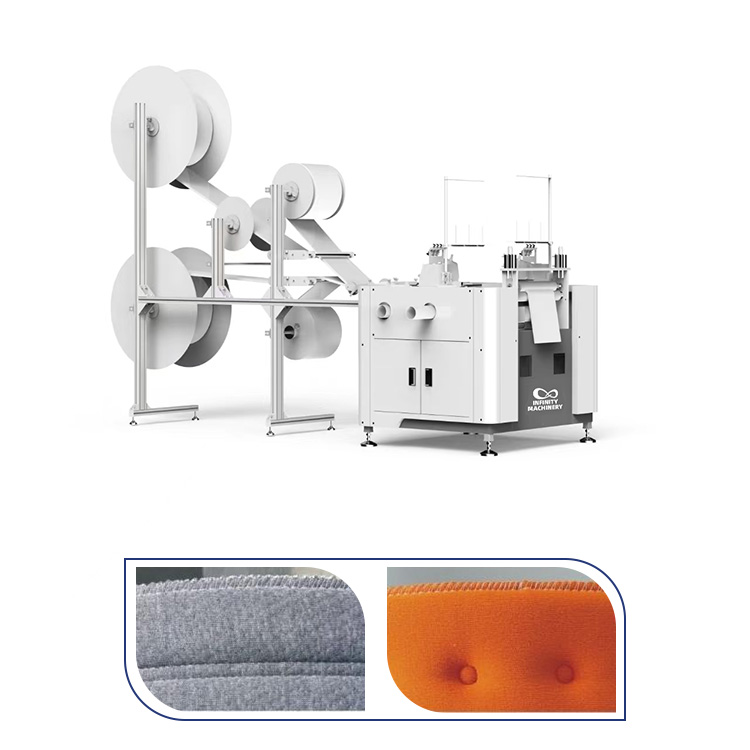
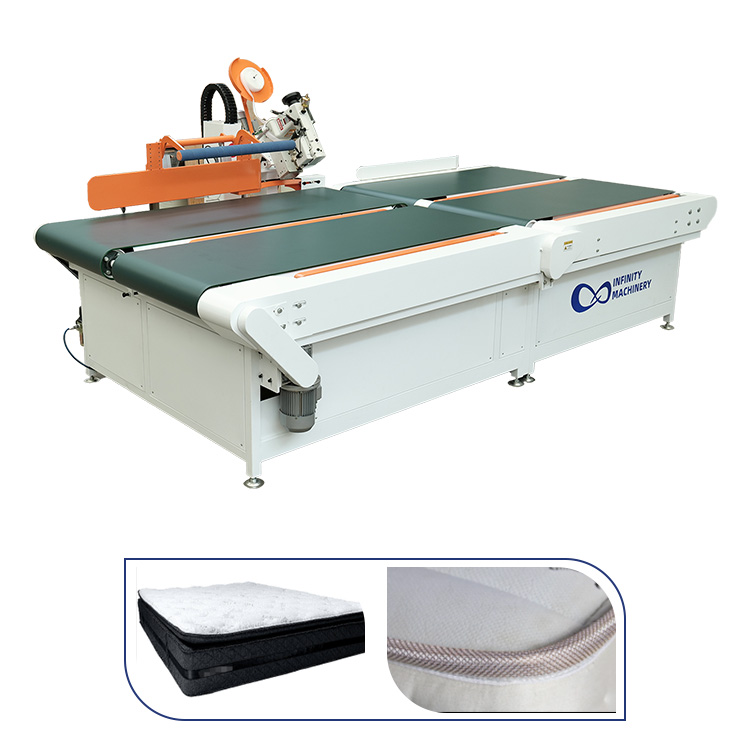
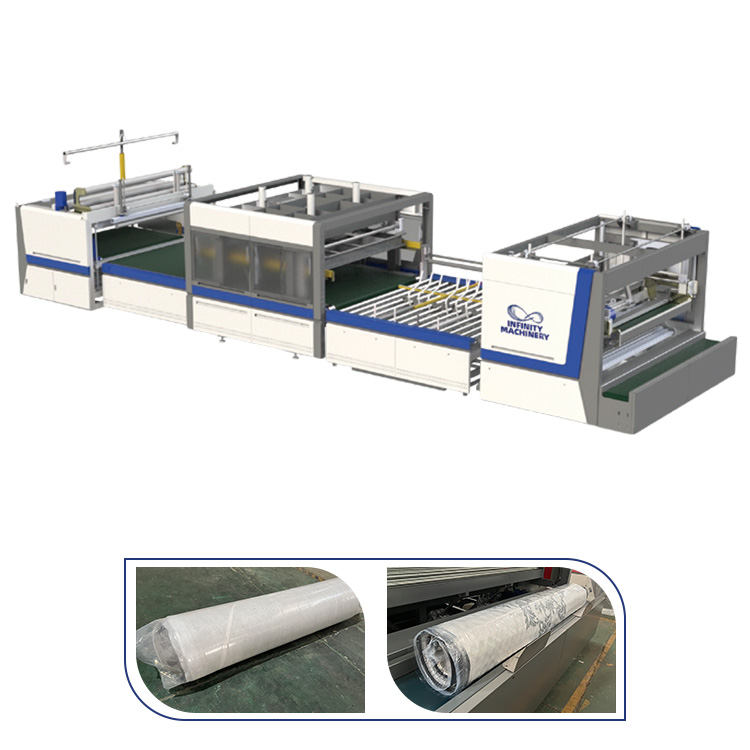
This guide covers the three essential stages of a modern mattress finishing line — sewing, tape edge finishing, and compression packing — and the key machines that make them efficient: the IF-SB-A2 Double-Head Sewing Machine, the IF-T4 Automatic Tape Edge Machine, and the IF-CR2 Automatic Roll Packing Machine.
We cover the workflow, typical throughput at each stage, common bottlenecks, and how to design a finishing line that produces 400-600 finished mattresses per shift without bottlenecks.
The first stage of the finishing line takes quilted panels and border fabric and joins them into a complete mattress cover. This is done by a panel sewing machine like the IF-SB-A2 Front and Back Double-heads Mattress Sewing Machine.
The IF-SB-A2 is a double-head machine that sews both the top and bottom panels to the border fabric simultaneously. This is critical for finishing line throughput because it eliminates the need for a second sewing pass:
The sewing station is typically the most labor-intensive part of the finishing line. Automating it with a double-head machine reduces the workforce from 3-4 workers (manual sewing) to 1 operator plus 1 material handler — a 50%+ reduction in labor costs for this stage.
After sewing, the mattress moves to the tape edge finishing stage. This is where a decorative tape strip is applied around the entire perimeter of the mattress and sewn through all layers. The IF-T4 Automatic Tape Edge Machine is the most popular choice for this stage.
The IF-T4 uses a high-speed lock stitch head to sew the tape strip around the mattress. Its key advantages in a finishing line:
The IF-T4 is typically faster than the sewing station (500-700 vs 400-600 mattresses/shift), which means it will not become a bottleneck. If your sewing station produces 500 mattresses per shift, the IF-T4 can handle that volume easily.
The final stage transforms a bulky finished mattress into a compact, shippable package. The IF-CR2 Automatic Mattress Roll Packing Machine compresses, rolls, and wraps the mattress in a single automated cycle.
The IF-CR2 is the fastest machine in the finishing line, which means it never becomes a bottleneck. Mattresses can flow directly from tape edge to packing with no queue buildup.
Here is how the three stages work together in a balanced finishing line:
| Stage | Machine | Cycle Time | Output/Shift | Workers |
|---|---|---|---|---|
| 1. Sewing | IF-SB-A2 | 1.5-2 min | 400-600 | 2 |
| 2. Tape Edge | IF-T4 | 45-90 sec | 500-700 | 1 |
| 3. Packing | IF-CR2 | 30-40 sec | 700-950 | 2 |
Total workforce: 5 people per shift (2 sewing + 1 tape edge + 2 packing) — down from 6-8 with manual methods.
Total cycle time per mattress: 3-4 minutes of combined machine time, with all three stages running in parallel on different mattresses.
Line throughput: Limited by the slowest stage (sewing at 400-600/shift). The tape edge and packing stages have spare capacity. To increase overall line output, add a second sewing station — this doubles total output to 800-1,200 mattresses per shift.
This is the most common issue. The sewing station is the slowest stage. Solution: Use a double-head machine like the IF-SB-A2 (cuts cycle time in half) or add a second sewing station.
If the tape edge machine needs frequent adjustments, check needle timing and tape guide alignment. The IF-T4 has auto-diagnostics that identify these issues before they cause downtime.
The IF-CR2 is faster than the upstream stages, but if mattresses arrive in batches rather than a steady flow, queues can form. Solution: Install a short buffer conveyor between tape edge and packing.
Workers walking between stations to move materials. Solution: Assign one dedicated material handler for the entire finishing line. A properly designed layout reduces walking distance by 50%+.
These three machines form the core of a professional mattress finishing line. Together they handle every stage from quilted panel to packed product.
A well-designed mattress finishing line balances throughput across all three stages. The IF-SB-A2 sets the pace at 400-600 mattresses per shift. The IF-T4 and IF-CR2 have built-in spare capacity to handle that volume easily. To scale up, add a second IF-SB-A2 sewing station — the rest of the line can handle the increased flow.
With 5 workers per shift and a total investment of approximately $40,000-50,000 for all three machines, a fully automated finishing line pays for itself within 6-9 months through labor savings and reduced shipping costs.
Our finishing line specialists can help you design the right combination of sewing, tape edge, and packing machines for your production volume. Get a free consultation and layout proposal.