Our mattress sewing station was the bottleneck of our entire production line. Every mattress that came off the quilting line had to pass through the sewing department before it could be finished, flanged, and packed. And the sewing department was slow, inconsistent, and expensive to staff.
Two machines changed everything: the IF-SB-A2 Front and Back Double-heads Mattress Sewing Machine for panel sewing, and the IF-SZX1 Linear Sewing Machine for straight stitching and border assembly. Together, they replaced six manual workers, cut our sewing time by 60%, and paid for themselves in less than three months.
This is the real story of how we transformed our sewing station — the problems, the machine selection process, the installation, and the actual financial results.
60%
Reduction in Sewing
Time per Mattress
6→2
Workers Needed
Per Shift
3 Mo.
Machine Payback
Period
The Problem: Our Sewing Station Was Costing Us More Than We Realized
Our factory produces approximately 250 mattresses per shift across three mattress sizes: twin, queen, and king. Before the upgrade, our sewing station operated with six workers per shift. Here is how the work was divided:
- Two workers sewing top and bottom panels to the border fabric using industrial walking-foot machines. Each panel took 4-6 minutes depending on mattress size.
- Two workers handling linear stitching — sewing the border strips to the correct length, adding reinforcement stitching, and preparing the border assembly for panel attachment.
- Two workers doing quality inspection, rework of defective seams, and material handling between stations.
The problems were obvious:
- Inconsistent quality. Each worker had a slightly different technique. Some pulled the fabric tighter, some left more seam allowance. The result was visible variation in seam quality across mattresses. About 8% of mattresses required rework at the sewing stage.
- Slow throughput. With six workers, we averaged 250 mattresses per shift. That is 41 mattresses per worker per shift — far below the industry standard for mechanized sewing.
- High labor cost. At an average wage of $12/hour per worker, our sewing labor cost was $576 per shift, or $2.30 per mattress. For a factory producing 125,000 mattresses per year, that is nearly $288,000 in sewing labor alone.
- Operator fatigue. By the fourth hour of a shift, seam quality degraded measurably. The majority of rework cases came from the second half of each shift.
- Training dependency. It took 3-4 weeks to train a new sewing operator to full speed. When workers left (which happened frequently in our labor market), production suffered for weeks.
We knew we had to mechanize the sewing station. The question was: what machines would give us the biggest impact?
Solution 1: The IF-SB-A2 Double-Head Mattress Sewing Machine — Eliminated the Panel Sewing Bottleneck
We installed the IF-SB-A2 Front and Back Double-heads Mattress Sewing Machine first. This machine is purpose-built for sewing the top and bottom panels of a mattress to the border fabric — exactly the step that required two of our manual workers.
The IF-SB-A2 has two independently controlled sewing heads: one for the front panel and one for the back panel. The operator loads the mattress onto the worktable, aligns the edge, and the machine sews both sides simultaneously. Key advantages over manual sewing:
- Dual-head simultaneous sewing. Both panels are sewn at the same time, cutting the panel sewing time by more than half compared to single-needle manual sewing.
- Direct-driven servo motors control the sewing heads with synchronous drive. Consistent stitch quality regardless of operator experience or fatigue level.
- Adjustable fabric expanding device that tensions the fabric evenly as it feeds through. This eliminated the puckering and uneven seam allowance that was common with manual sewing.
- Automatic cloth cutting mechanism. No more stopping to cut thread between panels. The machine trims automatically at the end of each seam.
- One operator runs the machine. The IF-SB-A2 replaced the two workers who previously handled panel-to-border sewing.
The immediate result: panel sewing time dropped from 4-6 minutes per mattress to 1.5-2 minutes. Quality improved visibly — the first 500 mattresses produced on the IF-SB-A2 had a rework rate of less than 0.5%, compared to the 8% we had been averaging with manual sewing.
The operator training was surprisingly quick. Our most experienced manual sewer reached full speed on the IF-SB-A2 in two days. A new hire with no sewing experience reached 80% speed in five days.
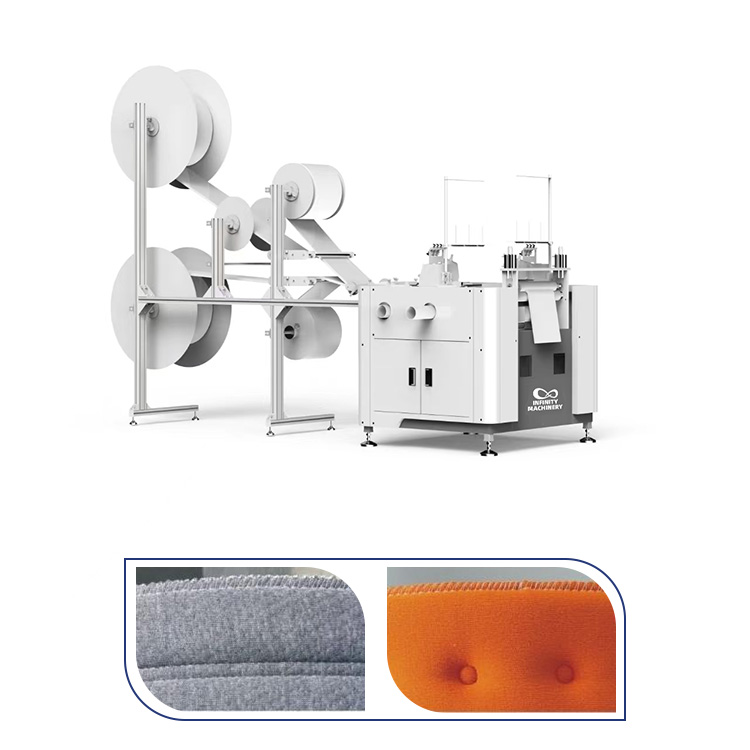
The IF-SB-A2 sews both mattress panels simultaneously with servo-controlled precision
Solution 2: The IF-SZX1 Linear Sewing Machine — Automated Border Preparation
With panel sewing solved, our next bottleneck was border preparation. Before the IF-SB-A2 could sew panels to borders, the border fabric had to be cut to length, stitched into a loop, and reinforced. This was the job of two additional workers.
The IF-SZX1 Linear Sewing Machine automated this entire process. This machine is designed specifically for straight-line stitching of border fabric — the long seams that connect the ends of a border strip and the reinforcement stitching along the border length.
- Automatic operation. The IF-SZX1 handles the entire linear sewing process automatically. The operator feeds the fabric, and the machine guides it through the sewing head with precise, consistent feed rate.
- Thread-breaking detection. The machine automatically stops if a thread breaks, preventing wasted fabric and incomplete seams. This feature alone saved us approximately $200 per month in rejected border material.
- Tailing materials stopping device. The machine senses when fabric has passed through completely and stops automatically. No wasted thread, no over-sewing.
- Servo motor control. Consistent stitch quality regardless of fabric thickness or type. The servo motor adjusts speed automatically to maintain optimal stitch density.
- One operator runs the machine. The IF-SZX1 replaced two workers on border preparation and added capacity for future production growth.
The IF-SZX1 processes border strips at approximately 3-4× the speed of manual linear sewing, with zero variation in stitch quality. Border preparation time dropped from 3 minutes per mattress to under 1 minute.
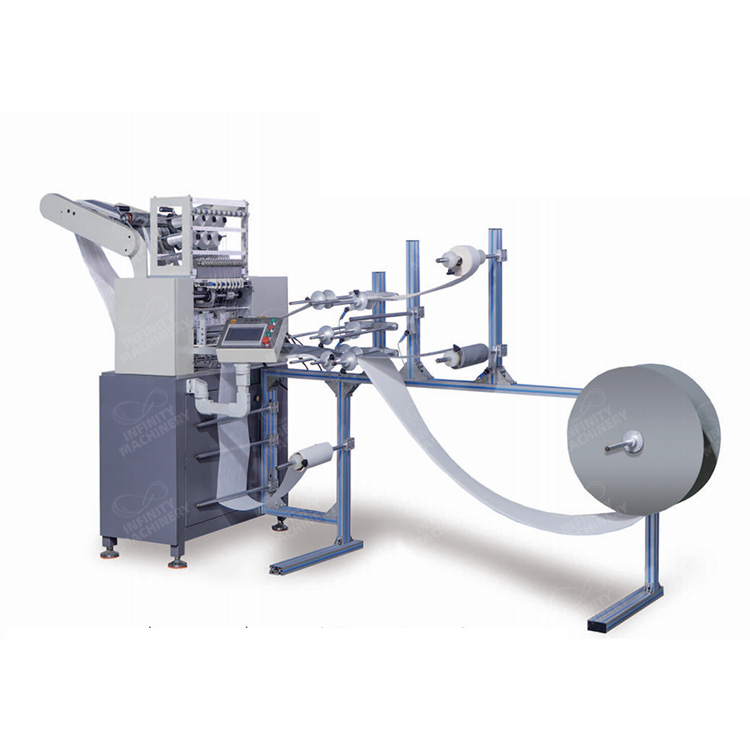
The IF-SZX1 automates border strip stitching with servo-controlled precision
How the Two Machines Work Together: The New Sewing Workflow
Here is how our sewing station operates now with the IF-SB-A2 and IF-SZX1:
- Operator 1 (IF-SZX1): Prepares border fabric. Feeds pre-cut border strips into the IF-SZX1, which stitches the end seam and adds reinforcement. Completed border assemblies are placed on a rolling cart between the two machines. This takes approximately 45 seconds per border.
- Operator 2 (IF-SB-A2): Takes the completed border assembly from the cart, places it on the IF-SB-A2 worktable along with the top and bottom panels, and starts the sewing cycle. The machine sews both panels simultaneously. Cycle time: 1.5-2 minutes per mattress.
- Material handling: Completed mattresses move to the flanging station on a short conveyor. One material handler can support both machines and manage the flow to downstream processes.
Total operators for the sewing station: two machine operators + one shared material handler = 3 people. Down from six. And the output increased from 250 mattresses per shift to 400+ — a 60% increase in throughput with half the staff.
IF-SB-A2 Double-Head Sewing
- Sews top and bottom panels simultaneously
- Direct-driven servo motors for consistent stitching
- Adjustable fabric expanding device
- Automatic thread cutting
- 1.5-2 min per mattress cycle time
- Replaced 2 manual workers
IF-SZX1 Linear Sewing
- Automatic border strip stitching
- Thread-breaking detection
- Automatic stop at fabric end
- Servo motor speed control
- 3-4× faster than manual linear sewing
- Replaced 2 manual workers
The Real Numbers: First Year ROI Analysis
Here is the complete financial breakdown of our sewing station transformation:
| Cost Factor |
Before (Manual) |
After (IF-SB-A2 + SZX1) |
| Workers per shift |
6 |
3 |
| Annual labor cost |
$172,800 |
$86,400 |
| Output per shift |
250 mattresses |
400+ mattresses |
| Rework rate |
8% |
<0.5% |
| Annual rework material cost |
$24,960 |
$1,560 |
| Labor + rework annual cost |
$197,760 |
$87,960 |
Total annual savings: $109,800 — a combination of $86,400 in reduced labor costs and $23,400 in rework material savings.
Investment: IF-SB-A2 at approximately $14,000 + IF-SZX1 at approximately $8,000 = $22,000 total equipment cost.
Payback period: 2.4 months. After the third month, every month of operation generates approximately $9,150 in net savings. Over five years, total savings exceed $500,000.
$109,800
Annual savings from
sewing station upgrade
60%
Increase in sewing
station throughput
94%
Reduction in
sewing rework rate
0
Operator training days
to reach full speed
3 Machines for a Complete Mattress Finishing Line
Based on our experience, here are the three machines every mattress finishing department should have. The IF-SB-A2 and IF-SZX1 cover the sewing station. The IF-T4 is the natural next step for factories ready to add tape edge finishing.
PANEL SEWING
Dual-head simultaneous panel-to-border sewing. Direct-driven servo motors, adjustable fabric expander, auto thread cutting. Replaced 2 workers for us.
LINEAR STITCHING
Automatic border strip stitching with thread-breaking detection. 3-4× faster than manual. Replaced 2 workers on border prep.
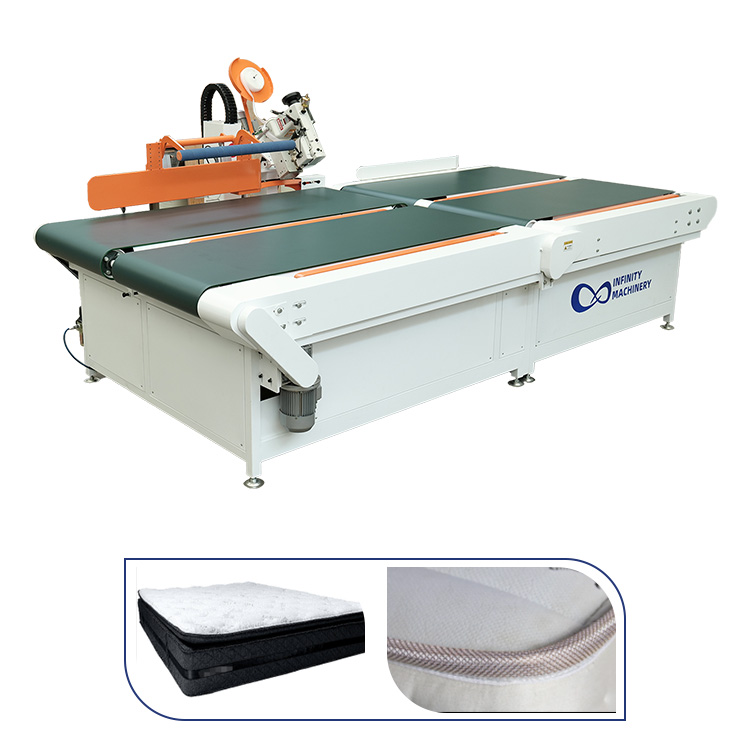
RECOMMENDED UPGRADE
Automatic tape edge finishing. High-speed chain stitch head. The logical next step after upgrading your sewing station.
What We Learned: Key Takeaways from Our Sewing Station Upgrade
- Your sewing station is the most overlooked bottleneck. Every mattress factory focuses on quilting, tape edge, and packing. But the sewing station — where panels meet borders — is where many production lines actually lose their throughput. Fixing ours increased overall factory output by 22%.
- Double-head sewing is a game changer. The IF-SB-A2's ability to sew both panels simultaneously seems like a minor feature, but in practice it doubled our panel sewing throughput and eliminated the quality variation between operators.
- Automatic linear sewing eliminates the hidden waste. Before the IF-SZX1, we did not realize how much time was lost to thread breaks, fabric misalignment, and re-measuring of border strips. The machine does all of this automatically at consistent speed.
- Operator training is negligible. We were worried about training our team on new equipment. In practice, both machines were easier to learn than the manual sewing techniques our workers had been using for years. A three-day training program was sufficient for both machines.
- The ROI math works even for small factories. We produce 250 mattresses per shift — a mid-size operation by industry standards. If your factory produces 100+ mattresses per shift, the IF-SB-A2 and IF-SZX1 will likely pay for themselves within 6 months or less.
Is Your Sewing Station Ready for an Upgrade?
If any of these sound familiar, your sewing station is the place to start:
- You have 4 or more workers dedicated to mattress panel sewing and border preparation
- Your sewing station is the slowest part of your production line
- Seam quality varies noticeably between operators or between shifts
- You are spending more than 5% of material costs on sewing rework
- Training new sewing operators takes more than two weeks
- You are running two shifts and the second shift has higher defect rates than the first
The IF-SB-A2 and IF-SZX1 together cost less than three months of the labor and rework waste they eliminate. In our case, the payback was 2.4 months. Everything after that is pure profit and production capacity that we never had before.
Ready to Transform Your Mattress Sewing Station?
Our sewing specialists can help you design the right combination of IF-SB-A2 and IF-SZX1 for your production volume and fabric types. Get a customized ROI projection for your factory.

